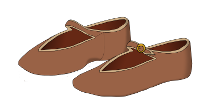
Shoes with doubled sole made after finds from Altenberg

Many, mostly complete, shoes have been found in abandoned mining adits in Altenberg, in Siegen-Wittgenstein in Nordrhein-Westfalen Germany, next to textile-, metal and other leather fragments. Except for one leather fragment all leather finds have been dated to around 1235 +- 6 years 1.

The special feature from the Altenberg shoes are the doubled soles at the front and the heel which where sewn to the main sole. These doubled soles have been used as an additional protection for the miner against sharp rocks2. They should not be mistaken as an additional measurement against the wear of the sole like additional inner soles found in Schleswig3 and Konstanz4 after 1200. The construction of the overall shoe is a turned shoe and should not be mistaken for a welted construction found in later periods. Doubled soles attached to welted shoes became common not before the 15th century5.

More
New trousers from yellow wool twill

Since I am currently moving all my equipment from chemical to vegetable dyed fabrics, it was time to exchange my old Hoses with new ones. The old pair of Hoses, shown in the following figure, were made of chemically dyed gray-mottled 2/2-woolen twill.

My old pair of Hoses made of chemical dyed 2/2 woolen twill

For these the surviving Hoses from the grave of the Archbishop of Bremen, dated to the first half of the 13th century, served as a model. This pair are in a good state of preservation and consists of 4 parts:

More
Shoetype: Type Apotekaren

Lace fastened low cut shoe with deep pointed instep vent - 2nd quarter 13th century till end of 13th century

Finds

Kolberg (PL) 1225-13001
Lund (SE) 13. Jhd.2
Schleswig (DE) 1250-13003 und 13. Jhd.4

Description

Low cut shoe with lace fastening over the vent and a deep instep point. The laces are sewn in to a pair of slits next to the instep point, or fixed via knots or loops. The most important characestic is the deep pointed instep vent which always has a fine edge binding all around. The instep point is not as deep as on the “Schleswig” type shoe. The top line has a slightly dipped side with a straight back.

More
Shoetype: Type Zürich

Lace fastened low cut shoe with deep pointed instep vent - 4. quarter 13th century till 1. quarter 14th century

Finds

Chillon Castle (CH)1, about 1275
Konstanz (DE)2
Schleswig (DE)3, after 1280

Description

A characteristic feature of this low cut shoe is the deep pointed instep vent. It is closed via two attached straps above the instep.

The vamp is cut in one piece with possible inserts at the side for larger sizes with a forward tilted closing seam on the medial side of the shoe. The straps for closing the shoe are not sewn to the vamp but are attached to the upper as one piece. Therefore this type of shoe consumes a lot of material. The heel is often raised a little bit. The top band is attached on the whole opening and ends in the first third of the strap. Some examples show stitches at the heel which come from reinforcements pieces sewn to the upper. All finds are adult sized shoes.

More
Turnshoes

Here you can find some examples for medieval turnshoes which I made. All are made of vegetable tanned leather and sewn with linen or hemp thread.